When you opt for any network, it remains the most confusing time to choose between cables. But if you are planning a new network installation or looking for upgrading to an existing network then you might consider using the Fibre optic cables.
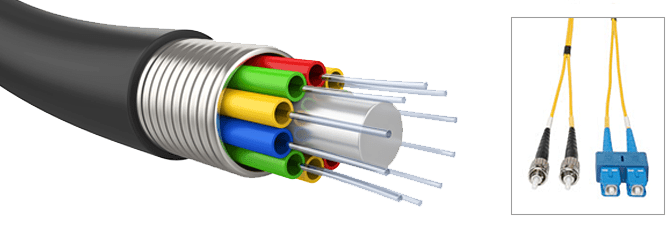
A fibre optic cable is also known as an optical-fibre cable, is used to carry the light and used for different applications, such as long-distance telecommunication, or providing a high-speed data connection between different parts of a building.
Fibre optic cables are well-known for their high durability and network carrying and have many advantages over the Ethernet cables. Some of them are mentioned below:
1. Greater Bandwidth:
Well, copper cables are specially designed to voice transmission and have limited bandwidth. Whereas, Fibre optic cable has greater bandwidth and more data carrying capacity than copper cables of the same diameter.
2. Faster Speeds:
Fibre optic cables have the capacity to carry light to transmit data from a single core. This allows Fiber optic to carry signals at speeds that are only about 31 per cent slower than the speed of light.
3. Longer Distances:
Fibre optic cables can carry signals for long distances. Fibre distances can range from 300 meters (984.2 ft.) to 40 kilometres (24.8 mi.), depending on the style of cable, wavelength, and network. Because fibre signals need less boosting than copper ones do, the cable performs better.
4. Security:
As fibre patch cables cannot be tapped easily, and this makes it different from high internet security. One can penetrate the fibre cable only by cutting the wire, which will then make the signal disappear.
It also enables you to put all your electronics and hardware in one central location, instead of making the closets with equipment throughout the building.
5. More Flexibility for the Future:
As compared to copper cables, Fibre cables are thinner and lighter in weight which makes them more flexible and pulls more pressure than copper wires and is less prone to damage and breakage.
Fibre optical cable has exclusive advantages such as ever-reducing cost, increased bandwidth, extremely high speed and long transmission distance, excellent reliability and perfect security, has replaced copper in every aspect of network transmission and reception.
 Networks Cables Blog